




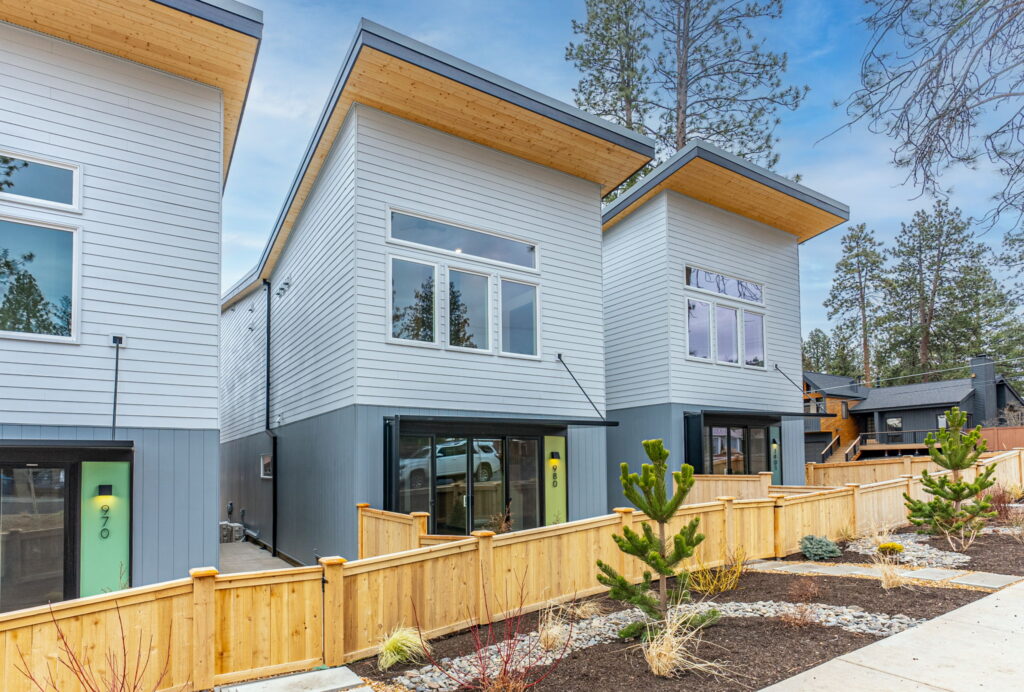
A rental property cap rate above 5% on new construction in Bend, Oregon doesn’t come around often. Bend’s property values are high, construction costs keep climbing, and the rental market has cooled from its pandemic peak. So when we say that Hiatus Ninth – our SFR + ADU twin homes in NE Bend – is penciling out at a 5.7% cap rate, the natural response is to pick up a red pen and start looking for holes.
We welcome it. Let’s get into the numbers.
First, a Quick Cap Rate Primer (For the Uninitiated)
If you’re already fluent in NOI and cap rates, feel free to skip ahead. But for those who are newer to real estate investing, here’s what we’re talking about.
Cap rate – short for capitalization rate – is one of the most common metrics investors use to evaluate a property’s income potential. The formula is simple:
Cap Rate = Net Operating Income (NOI) ÷ Property Value
Net Operating Income is just your total annual rental income minus your annual operating expenses (think taxes, insurance, maintenance – not your mortgage payment). The result is a percentage that tells you what kind of return the property generates based purely on its income, independent of how you finance it.
A higher cap rate generally means higher potential returns (but often more risk). A lower cap rate usually signals a more stable, lower-risk investment – think downtown Class A apartment buildings in major metros that trade at 4-5%.
For residential rental properties in secondary markets like Bend, a cap rate between 5% and 7% is considered strong, especially on new construction where maintenance surprises are minimal and tenant demand is high.
Now, let’s look at what 5.7% actually means at Hiatus Ninth.
The Income Side: $56,400 Per Year From a Single Lot
Each Hiatus Ninth property includes two independent dwelling units on one lot – a primary SFR home and an attached ADU. That’s two front doors, two leases, two income streams. Here’s what the rental picture looks like:
Unit 1 (Primary Home): $2,250/month → $27,000/year
Unit 2 (Furnished ADU): $2,150/month → $25,800/year
Utility Reimbursement: $300/month → $3,600/year
Total Annual Income: $56,400
Where do these numbers come from? Real leases on existing Hiatus homes in Ninth – properties that are already leased and performing in Bend’s rental market. And if you’ve been watching what we wrote earlier this year about these twin homes, you know the demand for well-designed, energy-efficient rental units in Midtown Bend isn’t theoretical. It’s proven.
For context, average rent for a two-bedroom apartment in Bend hovers around $2,000-$2,250, and these units command premium rates because they’re new construction, high-performance, and located in one of Bend’s most connected neighborhoods. Tenants aren’t renting square footage – they’re renting a lifestyle: walkable streets, proximity to Pilot Butte and Hollinshead Park, and future access to the Bend Bikeway Project route.
The Expense Side: $11,065 – And Why That Number Matters
Let’s talk expenses. This proforma reflects an owner-managed, fully-occupied scenario. Your numbers may look different depending on how you plan to hold the property – but here’s the baseline, line by line:
Property Taxes: $4,000/year (estimated for new construction)
Insurance: $1,125/year
HOA Fees: $70/month → $840/year
Utilities (actual cost): $300/month → $3,600/year
Maintenance & Repairs: $1,500/year
Total Annual Operating Expenses: $11,065
A few things worth noting here. The maintenance line at $1,500 per year – roughly 0.19% of property value – reflects the reality of high-performance new construction. Industry standard for older properties typically runs 1-1.5% of value annually, which on a $799,000 property would be $8,000-$12,000. New, high-performance homes – the kind with 10/10 Home Energy Scores, quality insulation, and modern mechanicals – simply don’t have the same maintenance burden as aging housing stock. That’s not optimism. That’s the advantage of building it right the first time.
The utility reimbursement structure is also worth calling out. The tenants pay $300/month toward utilities, which offsets the actual utility cost to the owner. For net-zero ready homes with optional solar packages, there’s even potential to bring that net utility cost down to near zero over time.
The Bottom Line: $45,335 NOI and a 5.7% Cap Rate
Here’s where it all comes together:
- Annual Rental Income: $56,400
- Less Operating Expenses: ($11,065)
- Net Operating Income: $45,335
- Property Value: $799,000
- Cap Rate: 5.7%
Let’s put that 5.7% in context. According to CBRE’s H1 2025 Cap Rate Survey, average multifamily cap rates across the U.S. are running between 4.75% and 5.5% for stabilized assets, with value-add properties ranging higher. For new construction residential in a secondary market like Bend, a 5.7% cap rate is competitive – particularly when you factor in the appreciation upside that Central Oregon continues to offer.
Why This Matters More Than the Numbers Suggest
Cap rates are important. But they’re a snapshot – a single frame in what should be a much longer film. Here’s what the 5.7% number doesn’t capture:
Appreciation potential. Bend remains one of Oregon’s fastest-growing markets. Remote work migration, lifestyle demand, and limited buildable land in neighborhoods like Midtown continue to support property values. And properties with ADUs? They appreciate faster. A 2025 FHFA study found they appreciated 22% more than comparable properties without them over a ten-year period. Two units on one lot isn’t just an income play. It’s a long-term equity play.
Rent growth. Rents in Bend have generally risen in recent years. Oregon’s statewide rent stabilization law caps annual increases for most units older than 15 years at the lesser of 7% plus CPI or 10% (9.5% for 2026). New construction is exempt from these limits for the first 15 years, providing investors flexibility to adjust rents as the asset matures.
Two income streams on one lot. This is the structural advantage that most single-family rentals simply can’t offer. If one unit turns over, the other is still cash-flowing. If you want to live in one unit and rent the other, you can do that too – and potentially qualify as an owner-occupant with better financing terms.
New construction = fewer surprises. No deferred maintenance. No aging roof or failing HVAC system hiding behind fresh paint. These homes are built to modern energy codes and beyond, which means lower operating costs from day one and a longer runway before major capital expenditures.
Financing flexibility. As we’ve written about before, some scenarios allow these homes can be financed with traditional residential loans – not commercial lending. That means potentially lower down payments, better interest rates, and a simpler qualification process than you’d face with a traditional duplex or multifamily acquisition.
Who Is This Property For?
The beauty of a two-unit property at this price point is that it works for a wide range of buyers:
The first-time investor who wants to “house-hack” – live in one unit and rent the other to offset their mortgage while building equity in a growing market.
The experienced landlord looking to add a cash-flowing asset in a desirable location with strong tenant demand and minimal management headaches.
The out-of-state buyer attracted to Bend’s quality of life and long-term growth trajectory, seeking turnkey rental income in a market they believe in.
The empty nester or downsizer who wants to live in one unit and generate supplemental income from the other – a strategy that’s increasingly popular among the demographics driving today’s housing market.
The Bigger Picture: Small Homes, Big Returns
We talk a lot at Hiatus about right-sized housing – homes that are built for how people actually live, not how we think they’re supposed to. The investment case for these homes follows the same philosophy. You don’t need a 3,000-square-foot single-family rental to generate meaningful returns. You need the right product, in the right location, with the right fundamentals.
A 5.7% cap rate on new construction in one of Oregon’s most desirable neighborhoods isn’t just a number. It’s a reflection of what happens when you design homes that match market demand – compact, efficient, thoughtfully built, and positioned for long-term value.
The numbers don’t lie. But sometimes… they need someone to tell the story behind them.
Interested in learning more about investing in Hiatus Ninth or exploring how these twin homes fit your financial goals? Reach out to Jenn to continue the conversation.



https://shorturl.fm/qVl3j